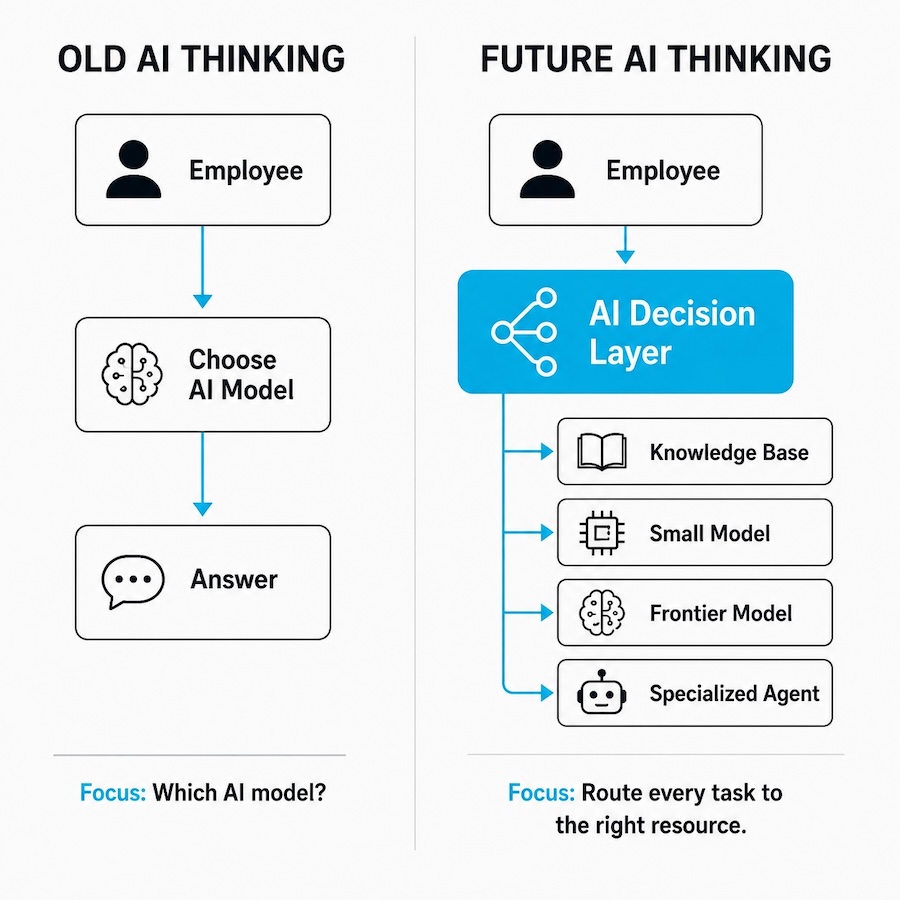
Enterprise AI is about orchestration, not models

For the past two years, enterprise AI conversations have been focused on one question: “What AI model should we standardize on?” That’s becoming the wrong question.
The question is shifting
The most pressing issue isn’t choosing the best model; it’s finding the most direct and efficient path to an outcome. As a user, I no longer care whether I’m using ChatGPT, Claude, or Copilot. I need the most accurate and useful output. A CFO, on the other hand, seeks the optimal outputs at the lowest cost.
We’re seeing foundational models rapidly advance and, in many cases, become interchangeable. The real differentiator is the ability to consistently deploy the optimal model, system, or resource for each task. Not every inquiry requires a heavy lift. For example:
Should a policy question or vendor scorecard inquiry go to ChatGPT or to an internal knowledge base?
Should a procurement analysis be handled by a domain-specific supply chain agent?
These aren’t just technology decisions. They’re business and economic decisions.
The rise of the AI decision layer
The path forward lies in routing requests to the optimal agent available within an enterprise’s AI ecosystem. An AI Decision Layer provides the logic to assess each request, determine its optimal destination, and execute the task to deliver the desired outcome through the best-fit model or resource.
The foundational question becomes: Which requests deserve frontier AI, and which can be handled by something far less expensive?
Within the next couple of years, employees won’t be choosing from an AI menu. The enterprise AI orchestration layer will automatically route each request to a search engine, an internal knowledge base, a lightweight model, a frontier model, or a specialized agent.
Orchestration becomes the competitive advantage
This recent Wall Street Journal article touches on the economics at play and the race to control AI spending. But the bigger picture is how enterprises build sustainable AI efficiency.
In industries involving complex multi-party transactions, such as supply chains and private markets, business leaders already understand the importance of orchestration centered around data and execution. That same approach will soon extend across AI infrastructure. Enterprises will increasingly deploy an AI Decision Layer: an orchestration system with guardrails that evaluates the complexity, security implications, business context, and underlying intent of every request before routing it to the optimal resource.
The organizations that create the most value from AI won’t necessarily be the ones with access to the most powerful models. They’ll be the ones that consistently route every task to the right resource at the right cost, with the right governance.
The best model won’t decide the next enterprise AI battle. The best orchestration will.